French Stressed Pronouns Worksheets for French 1 (Free Sample + Pack)
Download one free pronoms toniques worksheet for French 1 (student page and answer key, no sign-up). The full pack, Les pronoms toniques, is a 17-page PDF with five student pages in French, the same five with English directions, and one answer key for both, for USD 2.50 on TPT. A Quiz A/B companion checks the same four uses with two parallel one-page quizzes.
Free sample worksheet
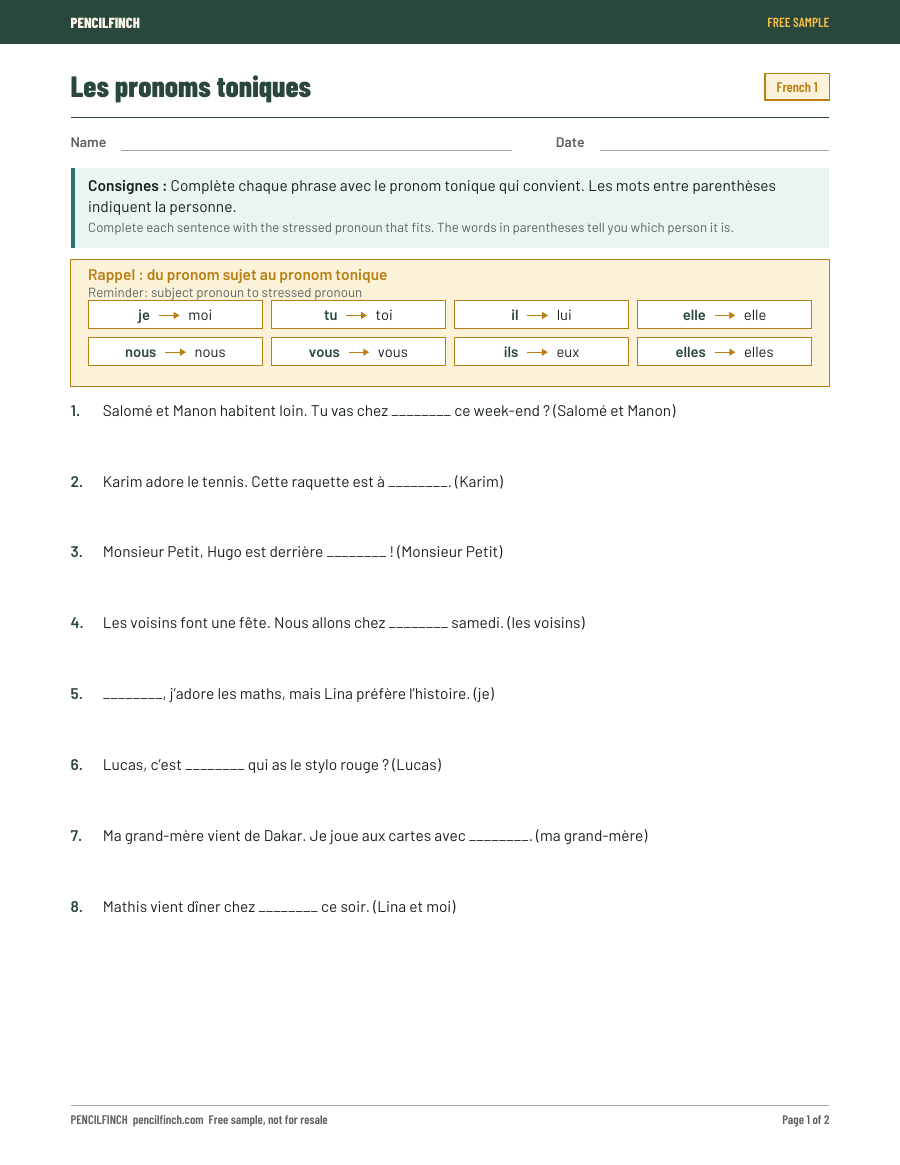 Download the free sample (PDF, 8 items with answer key)
Free to download, no email needed. These problems are not in the paid unit.
What is in the full unit
| Full unit | Les pronoms toniques - French 1 Worksheets en français - Grades 6-9 |
|---|---|
| Pages | 17 pages in one PDF |
| Answer key | Included with Rubric |
| Grades | 6-9 |
| Price on TPT | USD 2.50 |
Get the full unit on TPT (USD 2.50)
- A rule chart (R1) with the eight forms moi, toi, lui, elle, nous, vous, eux, elles, one example for each use, and two À retenir boxes: eux, elles and ce sont; aussi or non plus.
- A pronoun chart with fill-ins and eight multiple-choice items, then six emphasis rewrites and four English-to-French sentences.
- A nine-clue mystery code on the last page: when every preposition + pronoun is right, the code spells a French phrase, so students check their own work.
- Every student page printed twice, first with French directions, then with English directions and English rule explanations; items and answers are identical, so one answer key serves both.
- Two teacher pages: how to use the pack, both versions explained, standards, sources and terms.
The Quiz A/B companion (12 pages) adds a one-page Rappel and two parallel quizzes of 13 items each; item 1 of A tests the same skill as item 1 of B, so you can alternate rows or keep B as a retake.
Goes with
-
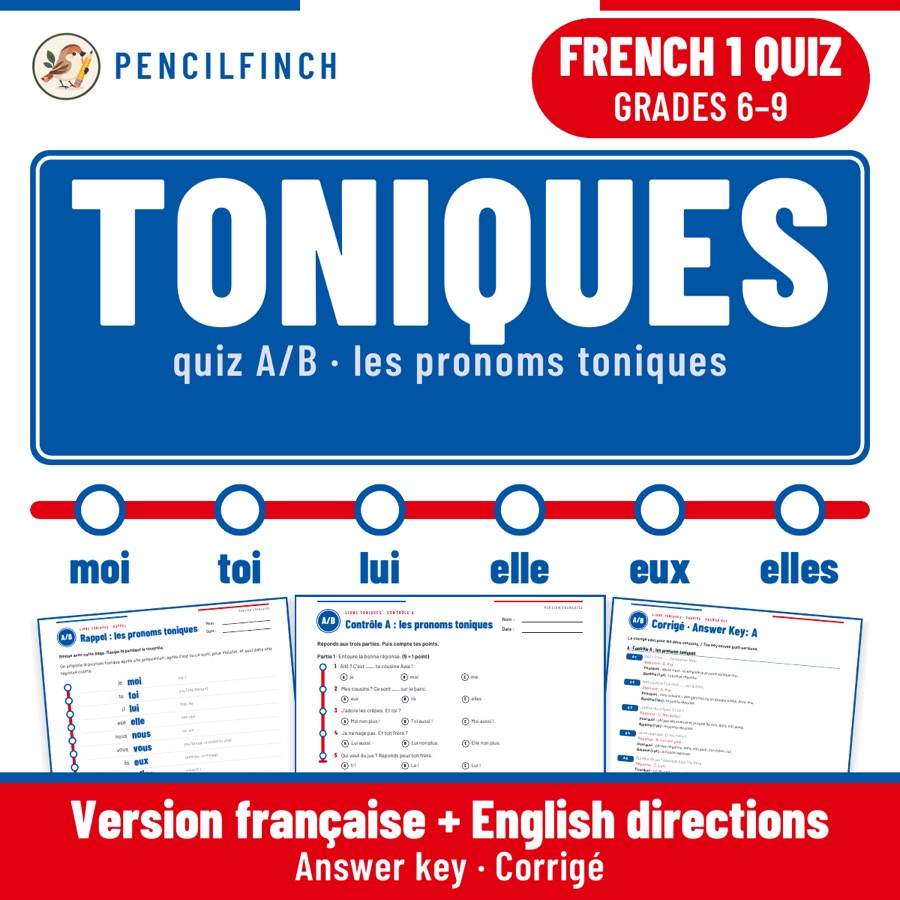
Les pronoms toniques - French 1 Quiz A/B en français - Grades 6-9
Companion. 12 pages, grades 6-9, answer key included. USD 3.00
View on TPT
Pages from the unit
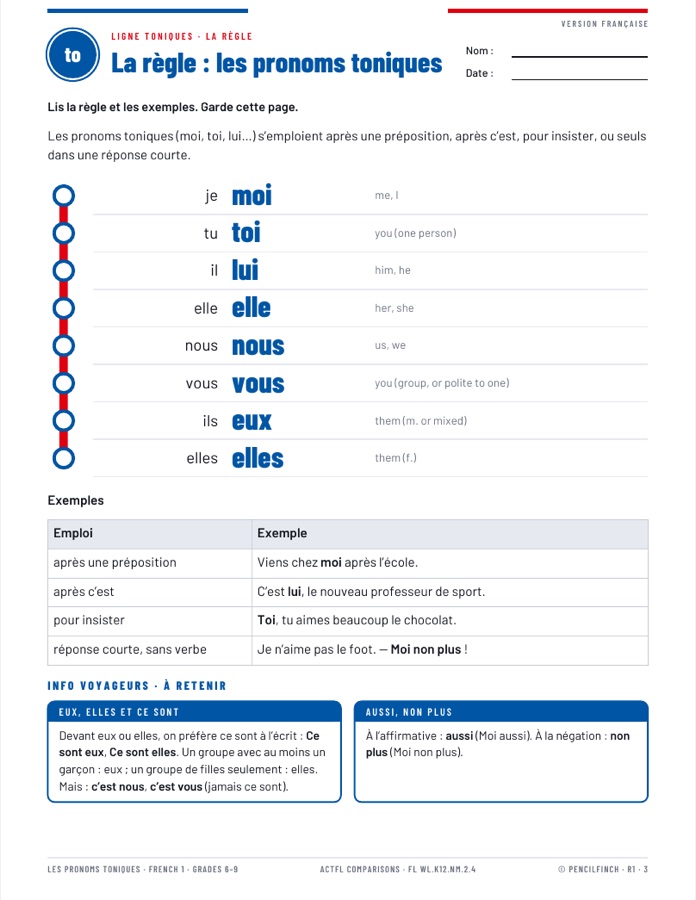
Page 3 of 17 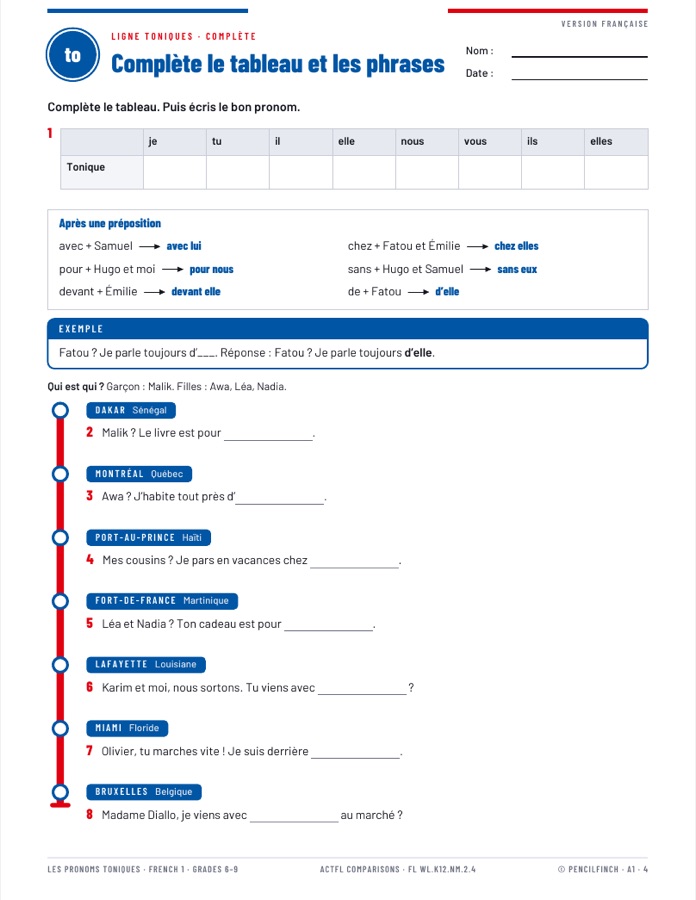
Page 4 of 17 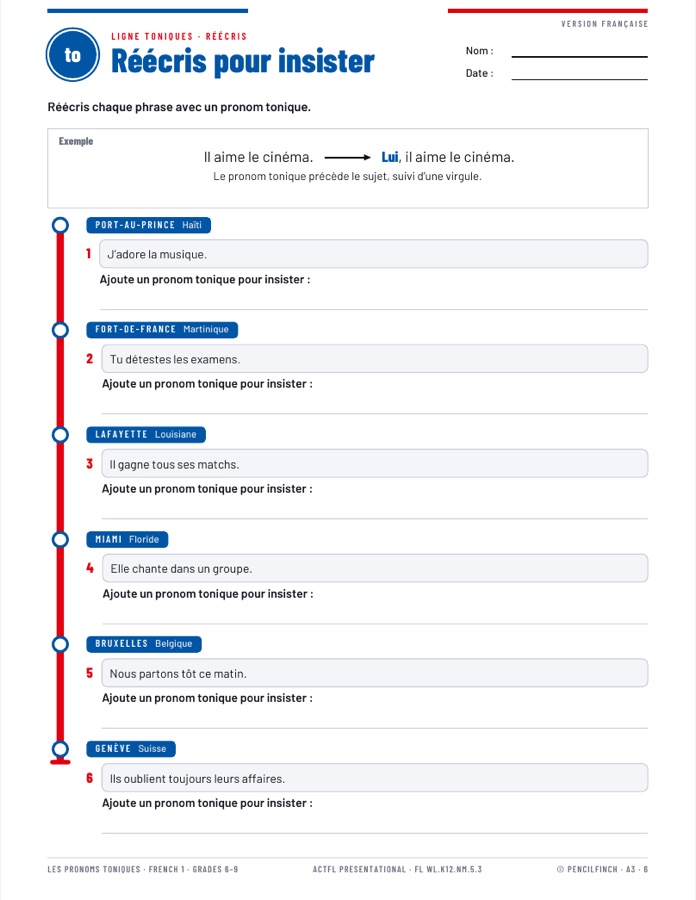
Page 6 of 17 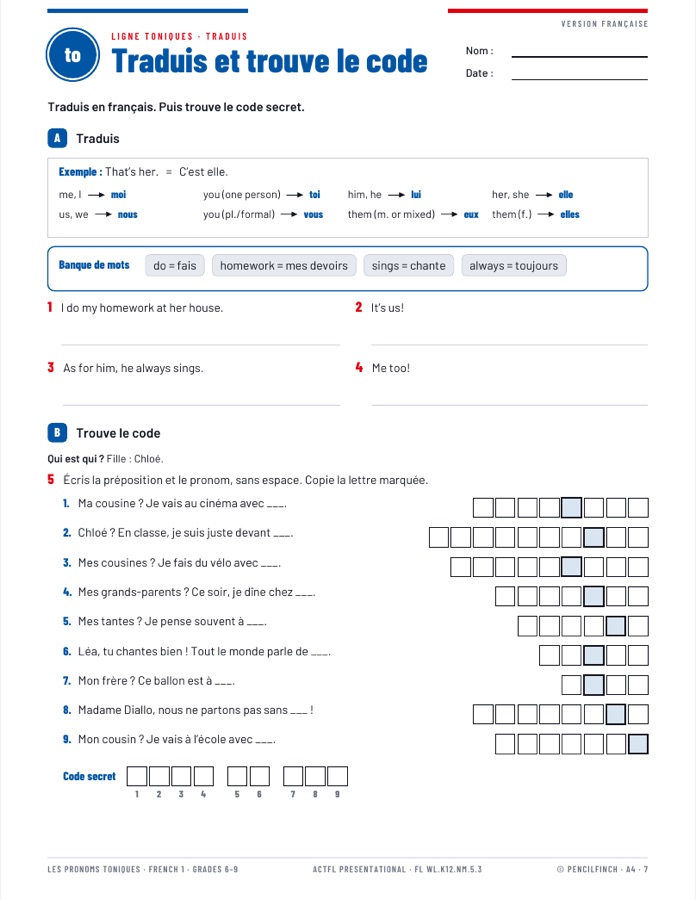
Page 7 of 17
How teachers use it
A stressed pronoun (pronom tonique, also called disjunctive pronoun) is the form of a personal pronoun that stands apart from the verb. There are eight: moi, toi, lui, elle, nous, vous, eux, elles. French 1 students meet them in four places: after a preposition (Viens chez moi après l’école.), after c’est or ce sont (C’est lui, le nouveau professeur de sport.), before the subject for emphasis (Toi, tu aimes beaucoup le chocolat.), and alone in a short answer with no verb (Moi non plus !).
Hand out the rule chart (R1) first and let students keep it on the desk. The chart does not ask for memorization in the abstract: each row pairs a subject pronoun with its stressed form and a short English gloss, so the pack fits the week after you introduce the forms, or a review day before a test.
The pages are light and mostly white, so they print well in black and white for a sub plan or homework. The English-directions copy is the one to send home with beginners; the French copy works for a class that reads French directions.
The Quiz A/B set is built to be given after the practice pack. Its teacher page maps each quiz part back to the practice page to reteach, and every sentence in the quiz is new, so a student who did the pack has not seen the quiz items.
Before and after this topic
Many French 1 courses teach adjective agreement before the stressed pronouns, so the agreement pack comes first in this hub.
- Before this topicFrench Adjective Agreement Worksheets, French 1 (Free Sample + Pack)
- All topics in this lineFrench 1 Worksheets and Quizzes
Common questions
How do I explain eux versus elles for a mixed group?
The pack states the rule on the chart: a group with at least one boy takes eux; a group of girls only takes elles. The example in the pack is Ce sont eux for a mixed or masculine group and Ce sont elles for a feminine group.
Is it c’est eux or ce sont eux?
The pack follows the OQLF guidance it cites: in writing, ce sont is preferred before eux and elles (Ce sont eux.), while before nous and vous only c’est is possible (C’est nous.). No item in the pack or the quiz asks students to choose c’est or ce sont before eux or elles: the quiz prints Ce sont in the sentence and asks only for the pronoun. C’est eux is common in speech, so you can accept it orally.
Students write Moi aussi when the sentence is negative. What does the pack do about it?
The chart has a box for it: aussi after an affirmative, non plus after a negative (Je n’aime pas le foot. Moi non plus !). The multiple-choice page and the quiz both include short-reply items so the contrast gets practiced, not just read.